5 tech essentials you shouldn't travel without
Five inexpensive items that cover almost everything on a trip — from the one charger you actually need to a tracker in your checked bag.

Travelling with tech is always the same dilemma: pack too little and you are stuck in an airport with a dead phone, or pack too much and carry weight you never use. After a few trips it becomes clear that the essential list is short. Five items cover almost everything — and none of them is expensive.
*This article contains affiliate links. If you buy through them, VectoByte may earn a small commission at no extra cost to you.*
1. One 65W charger (and only one)
The classic mistake is packing the laptop charger, the phone charger and the one for your earbuds. A single 65W USB-C charger replaces all three.
If you can, pick a GaN one. Gallium nitride is the material that replaced silicon inside chargers. It runs cooler, which is what allows the shrinking: a 65W GaN charger is smaller than the original brick of many laptops — and still gives you two or three ports.
What to check before buying:
- 65W is the sweet spot. It handles most thin-and-light laptops and charges a phone at full speed.
- Foldable pins, otherwise it will tear the lining of your bag.
- At least one USB-C port with PD (Power Delivery). Without PD, the advertised wattage never actually arrives.
2. A magnetic power bank
An ordinary power bank means carrying a cable and having your phone tethered to it inside your pocket. A magnetic one snaps onto the back of the phone and charges wirelessly — you keep using the device while it charges, standing in the boarding queue.
Two rules that save trouble:
- Power banks always fly in your carry-on. In checked luggage they are prohibited. Most airlines cap spare batteries at 100Wh, and magnetic ones sit well below that.
- Check that it also has a cable port. Wireless charging is slower and runs warmer; to fill the phone quickly, the cable still wins.
One detail that matters in practice: the stronger the magnet, the less it slides off when your phone is in a thick case.
3. A case just for cables
The cheapest item on this list, and the one that changes daily travel the most. Without it, cables become one knot at the bottom of your backpack, and you end up unpacking everything on the X-ray belt because security asked you to take the electronics out.
A case fixes that: every cable in its slot, everything comes out as one piece. Pick one with room for the charger and the power bank together, ideally hard-shelled — it protects what is inside when the bag gets thrown into a boot.
4. Noise-cancelling earbuds
Aircraft noise is low and constant — exactly the kind of sound that active noise cancelling removes best. This is not about playing music louder; it is about landing without the dull exhaustion of six hours of turbine in your ears.
What actually matters:
- Real ANC, not "passive isolation" dressed up in the listing.
- Over 20h of battery with the case, so you are not hunting for a socket.
- Multipoint, if you switch between phone and laptop.
Models in the 30-40 euro range already do an honest job. The gap to the 300 euro ones shows up in music, not on a plane.
5. A tracker in your checked bag
A Bluetooth tracker the size of a coin, dropped inside the suitcase. It will not stop your luggage from getting lost — but when it does, you open the app and see that it stayed in Madrid, while the airline is still saying "we are checking".
That has become a real argument at the complaints desk. Just confirm the listing says works with Find My (Apple) or with the Android network. Many cheap tags only work with a proprietary app that has no network behind it — which means a range of ten metres, not of the world.
What to leave at home
- A very cheap universal plug adapter. It is the single item most likely to cause an electrical accident abroad. If you take one, take a certified one.
- A USB-C hub, if you don't use one at your desk. On the road you will use it even less.
- A second cable of everything. One good USB-C cable and an adapter is enough; two of each is dead weight.
The final tally: five items, somewhere between 80 and 120 euros in total, and a backpack that handles any week-long trip.
Frequently asked questions
› Can I put a power bank in checked luggage?
No. Spare lithium batteries may only travel in carry-on luggage, because of the fire risk in the hold.
› How many mAh can a power bank be?
Most airlines cap spare batteries at 100Wh. A 20,000mAh power bank sits at roughly 74Wh and passes without trouble; above 27,000mAh you start bumping into the limit.
› Is a 65W charger enough for a laptop?
For most thin-and-light laptops, yes. Machines with a dedicated graphics card usually ask for 100W or more.
Related deal
 AliExpress
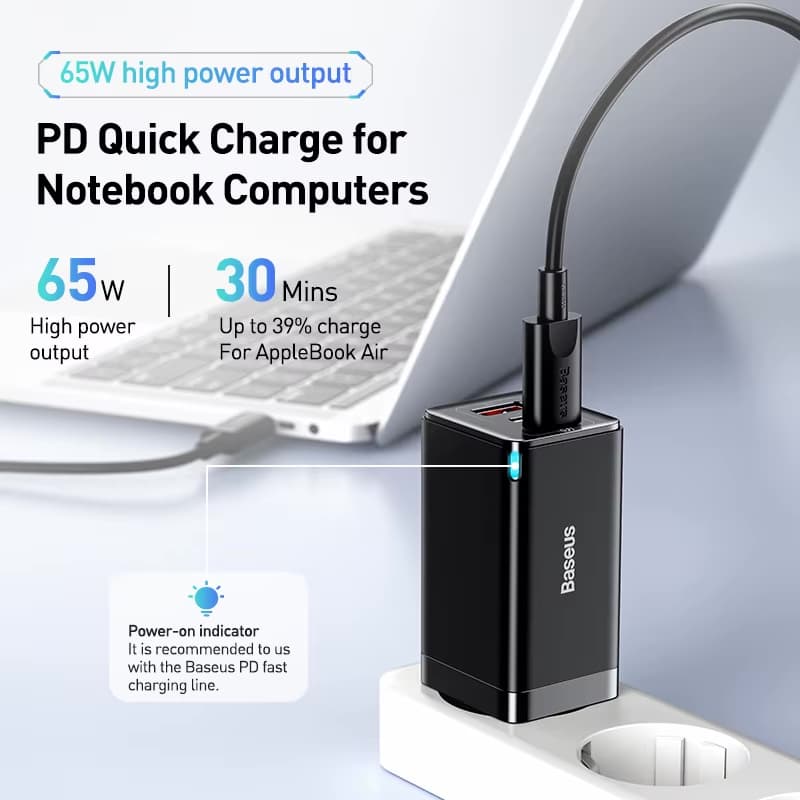
Baseus 65W USB-C PD charger
One charger for both laptop and phone, with USB-C and USB-A.
See current price
You might also like

Nvidia acquires Hugging Face for $13 billion
Nvidia announced the acquisition of Hugging Face for $13 billion, marking a significant move in the AI sector.
Read article · 3 min read
AMD Acquires Taalas to Boost Inference Performance
AMD has acquired Taalas to enhance inference performance by embedding models in silicon, a promising innovation in the AI sector.
Read article · 4 min read
Intel Stock: Analysis of Q2 2026 Earnings Report
Discover how the Q2 2026 earnings report impacted Intel's stock and what to expect for the future.
Read article · 4 min read